
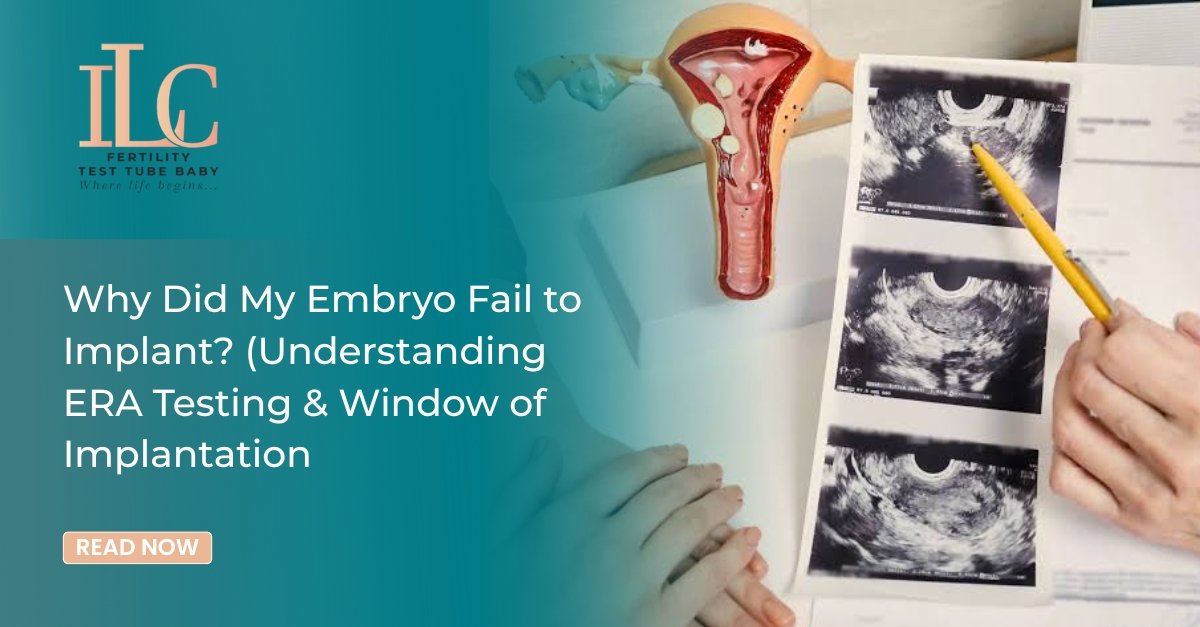
If you’ve gone through IVF and your embryo didn’t implant, you’re probably asking, “why?” It’s one of the hardest parts of this journey. Sometimes the answer lies with the embryo itself. But sometimes, it’s about timing — whether the embryo reached your uterus at the exact moment it was ready to receive it.
What Is the Window of Implantation?
Your Uterine lining isn’t receptive all the time. It has a few days in each cycle during which it allows an embryo to attach to its surface, also known as the window of implantation (WOI). This happens for most women between the 19th and the 23rd day of a standard 28-day cycle, but may vary by individual.
During this time frame your uterine lining (endometrium) experiences hormonal changes that make it “sticky” for embryos to attach and thrive. If the embryo arrives too early or too late, even a genetically healthy embryo may not implant.
Why Might the Window Be Shifted?
For most women, the window falls in the typical range. But for others, it can be earlier or later than expected. This is sometimes seen in women with a history of failed implantation, though it can also happen without any obvious cause.
What Is ERA Testing?
ERA stands for Endometrial Receptivity Array. It’s a test that looks at gene activity in a small sample of your uterine lining to check whether it’s receptive, or not yet ready, or has already passed its receptive phase, at the time the sample was taken.
The idea is simple: if your natural window is shifted, adjusting the timing of your embryo transfer to match your personal window may improve the chances of implantation.
How Is the Test Done?
It involves a small biopsy of the endometrium, done in a cycle that mimics your actual transfer cycle. The tissue sample is then analysed in a lab, and the result tells your doctor whether your window is standard or needs adjusting.
Is ERA Testing Right for Everyone?
Not necessarily. It’s usually considered for women who’ve had repeated implantation failure with good-quality embryos, where timing might be a missing piece.
It is important to be aware that further research is ongoing into ERA — some studies have demonstrated its effectiveness for some patients, especially those with previous failed transfers; others have not been convincing as to its overall effectiveness.
This is exactly why it should be discussed with your doctor as part of your specific case, not used as a routine step for every patient.
Talk to Dr. Heena About Your Options
Failed implantation can happen for several reasons, and timing is just one piece of the puzzle. If you’ve had one or more unsuccessful transfers, it’s worth having a detailed conversation about what might be going on in your case.
Book a consultation with Dr. Heena to understand whether ERA testing or another evaluation is the right next step for you.